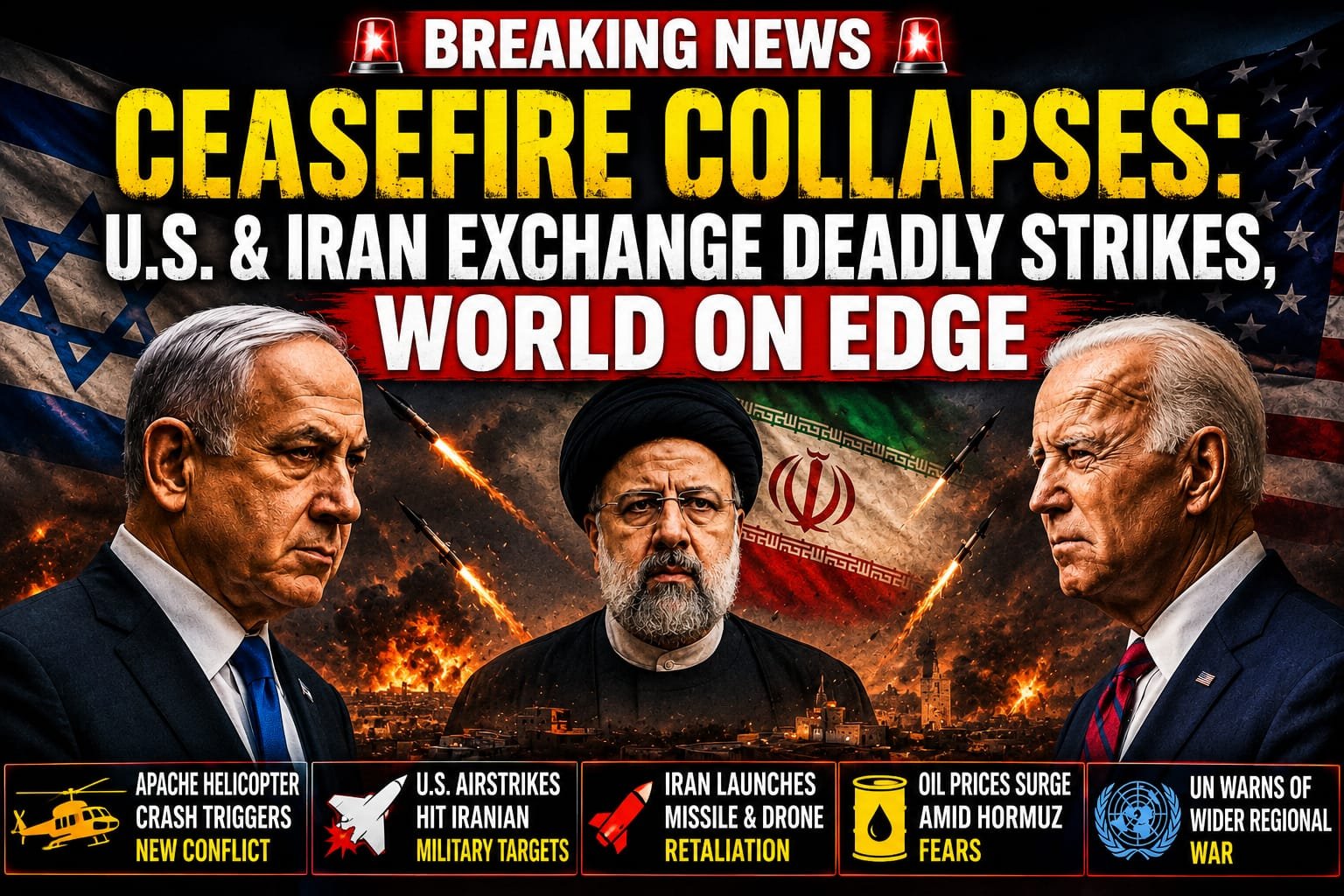
The short peace in West Asia is completely over. Following a dramatic clash in the sky, the United States and Iran have broken their two-month ceasefire and started directly attacking each other again. This sudden conflict has shocked the global community and made people worry about a larger war.
How the Fighting Started
The trouble began when a U.S. Army AH-64 Apache attack helicopter went down in the strategic waters off Oman, near the Strait of Hormuz. U.S. defense officials stated that the helicopter crashed after colliding with an armed Iranian Shahed drone.
The political fallout was instant:
• The U.S. Side: President Donald Trump blamed Tehran for the crash. He posted a warning on social media stating that Iran had taken "too long to negotiate" a peace deal and that they would now "have to pay the price."
• The Iran Side: Iran’s Foreign Minister, Abbas Araghchi, claimed that foreign militaries operating so close to Iran face a "constant risk of human errors or plain accidents." He bluntly told Western forces to leave the region if they want to stay safe.
A Historic Rescue by a Robot Boat
Even though the situation was highly dangerous, both American pilots were saved. This incident marked a major milestone in military history: the first time an uncrewed robot boat was used to rescue humans at sea.
The U.S. Navy sent a 24-foot autonomous vessel called The Corsair, operated by its AI-focused Task Force 59. Using smart sensors to see in the pitch-black waves, the robot boat located the pilots within two hours, pulled them out of the water, and brought them safely to a pickup spot.
The U.S. Launches Heavy Airstrikes
Soon after the crash, U.S. Central Command (CENTCOM) launched heavy retaliatory airstrikes against targets along Iran's southern coast.
American fighter jets heavily bombed radar stations, missile systems, and drone control bases in Iranian port towns like Bandar Abbas and Jask. At the same time, Washington placed strict new economic punishments on international networks helping Iran build weapons.
Local Impact: Iranian state media reported that the U.S. bombs destroyed two large water reservoirs in the town of Sirik. This has left about 20,000 local residents without clean drinking water during intense summer heat.
Iran Strikes Back with Missiles
Iran did not back down. Moving quickly with a doctrine of swift retaliation, Iran launched a massive wave of ballistic missiles and explosive drones across the region.
Iran targeted military bases housing American soldiers in neighboring countries, including Jordan, Kuwait, and Bahrain. Air raid sirens woke up citizens across the Gulf. Fortunately, the air defense networks in Jordan and Kuwait worked well and shot down most of the incoming weapons.
Peace Talks Stop and Oil Prices Rise
This fighting happened at the worst possible time. Just before the crash, international mediators were highly optimistic that a permanent peace treaty was close to being signed. Now, those peace talks are completely frozen. United Nations Chief Antonio Guterres has warned that this small conflict could easily grow into a full-scale regional war.
Why this matters to the rest of the world:
• Gas and Oil: Global crude oil prices quickly jumped close to $100 a barrel. Markets are panicked that the Strait of Hormuz—the world's most critical energy route—could be completely closed by the fighting.
• Shipping Chaos: Because cargo ships are taking long, expensive detours to avoid the danger zone, global trade is slowing down. This is causing unexpected shortages around the world, from beverage cans in India to life-saving food aid in East Africa.
Both sides are refusing to back down, and the world is watching closely to see what happens next.


Comments (0)
No comments yet. Be the first to comment!